

When companies expand, they usually focus on four areas: market size, competition, regulations, and sales channels. Almost nobody considers language.
The true cost of entering a new market only shows up months later. Language is often treated as a small, final task, but it behaves like a major strategic priority. Yet, it controls your launch date and determines whether you enter a market on time.
Every expansion strategy relies on a language strategy, whether you plan for it or not. Launching in a new country means communicating with new customers, partners, regulators, and employees. Every single relationship relies on clear communication, and each one brings its own legal risks and tolerance for mistakes.
Here is why a language strategy is essential for your company’s global growth and how to fix the expansion bottleneck.
Why does ignoring language actually cost you?
When companies treat language as a final administrative step, the price is paid later: lost deals, unanswered proposals, and delayed market entries. Research across three major studies measure the exact scope of this hidden loss:
- Economic loss: A UK government-backed study found that language ignorance costs up to £48 billion a year in lost trade (3.5% of national income). Companies that understand local languages and cultures spot and win far more sales.
- The hidden takeaway: Firms reporting no cultural issues abroad had export-to-turnover ratios at least 46% lower than firms that hit difficulties. Largely because the ones encountering no friction were the ones not selling much abroad in the first place
- Lost business: European Commission research estimates that 11% of small and medium businesses lose contracts directly due to language barriers.
Companies that build language into their expansion strategy early get to market faster.
Why language becomes a bottleneck
Language work is usually pushed to the very end of the project: the product is done, marketing is approved, and only then does someone ask for a translation.
This creates four major problems:
- Launches get delayed by paperwork: A product can be completely ready, but it cannot launch until manuals, safety labels, and software text are translated and signed off.
- Regulatory approvals slow down: Regulators have strict language rules. Inconsistent words across documents lead to extra questions, adding weeks of delays.
- Inconsistent terminology across teams: Without official translated materials, local teams write their own pitches. Product claims change, names differ across decks and websites, and legal teams find out too late.
- Customers walk away silently: People rarely complain about poorly adapted content. They just stop reading and leave. This shows up as low sales rather than a clear error, making it hard to track.
Language failures show up quietly as missed dates, answered queries, and underperforming markets.
Why traditional solutions fail
When faced with delays, companies usually choose between two approaches:
|
Strategy |
Main Advantage |
Main Drawback |
|
Human-Only |
High accuracy and accountability |
Slow and hard to scale |
|
AI-Only |
High speed and low cost |
Unchecked risk and no accountability |
1. The Human-Only Route
- Pros: High quality, legal accuracy, and clear accountability.
- Cons: Slow and hard to scale. Qualified language experts in specific industries are rare. When volume increases or deadlines move, human teams cannot keep up.
2. The AI-Only Route
- Pros: Fast, cheap, and available 24/7.
- Cons: Fast output is not verified output. Unchecked AI shifts all the risk back onto your business. If a contract clause, medical instruction, or legal claim is wrong, no human has taken responsibility for it. Savings upfront turn into big liabilities later.
A modern approach: content risk levels
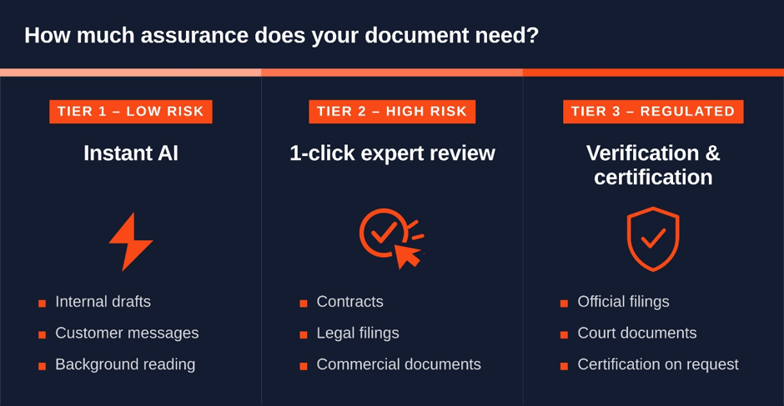
You are accountable for accuracy on every document your organisation sends and sorting them by risk is what lets you put full verification where a mistake would be a regulatory problem.
- A regulatory filing or legal contract has severe consequences if wrong.
- A marketing email or internal memo carries very little risk.
The true innovation lies in knowing when each tool is needed, rather than forcing your whole company to choose between only AI or only humans. This approach is called hybrid verification, and it forms the core principle behind Guildhawk's GAI Translate.
With GAI Translate, you can match the level of care to the level of risk in each document.
This model does not remove the need for human judgment. Someone in your business still has to decide which files carry high risk, and sorting files incorrectly is the one mistake software cannot prevent on its own.
What it does remove is the technical hassle: there are no complex software setups, no specialised translation tools to learn, and no long feedback loops to train the system. Instead, organisations gain access to expert human review on demand, consistent terminology through translation memories and glossaries, certification in the form the destination market accepts, support for common business file formats, and seamless integration with existing platforms.
|
Strategy |
Main Advantage |
Main Drawback |
|
Human-Only |
High accuracy and accountability |
Slow and hard to scale |
|
AI-Only |
High speed and low cost |
Unchecked risk and no accountability |
|
Hybrid Verification |
Fast, scalable, and legally safe |
Requires smart content sorting |
This approach gives you speed where speed matters, and certainty where risk is high, with fast turnarounds on expert review and verification.
Fast growth requires fast understanding
Successful global companies remove obstacles before they turn into bottlenecks. Treating language as key infrastructure, rather than a last-minute chore, helps you open new markets faster and execute launches with confidence.
Ultimately, language intelligence is about knowing which documents carry your company's greatest risks, deploying the right mix of AI and human expertise, and making sure your global expansion moves at the speed of your ambition. If you're planning to enter a new market, the question is not whether language will affect your success, but whether you've planned for it early enough.
About Guildhawk
Guildhawk is a British language-intelligence company founded in 2001 and headquartered in London. It combines 3,000+ vetted, certified linguists across 200+ languages with proprietary AI built in its own UK Gai Labs, delivering every project with a defensible audit trail. Guildhawk is ISO 27001 certified, a Queen's Award winner and a 2025 Safety and Security Entrepreneur Awards (SSEAs) winner, and processes work inside a secure ISO 27001 confidentiality envelope. Its GAI Suite of proprietary AI tools provides secure, advanced agents for AI translation with 1-click human-in-the-loop, anomaly detection and data anonymisation. Clients include global law firms, life-sciences, energy, financial and government organisations.
Ready to accelerate your market expansion?
Contact our team today to discover how hybrid language intelligence can speed up your next launch.

