

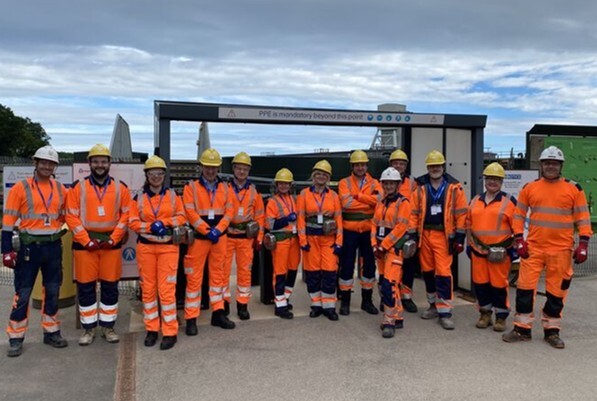
How do we inspire more boys and girls to pursue careers in engineering and construction?
Perhaps the answer lies not in classrooms or careers fairs, but deep beneath the North Yorkshire Moors, where one of the most ambitious engineering projects in modern Britain is quietly taking shape.
Recently, Anglo American kindly invited our Director David Clarke and alongside colleagues from ABMEC, to visit the remarkable Woodsmith Mine. What he witnessed was a powerful reminder of why engineering remains one of humanity’s most important professions.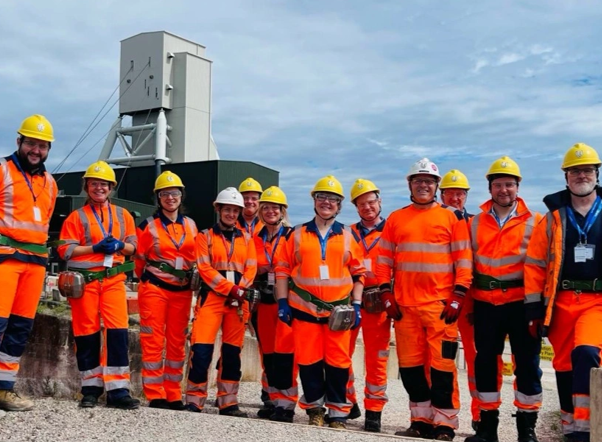
A hidden mega-project beneath the moors
From the surface, little prepares you for the sheer scale of what is being built below ground. Woodsmith is a vast underground mine, effectively the size of a town, designed to access the world’s largest known deposit of polyhalite, a naturally occurring multi-nutrient fertiliser containing potassium, sulphur, magnesium, and calcium. These nutrients are essential for improving crop yields and supporting sustainable food production for a growing global population.
This is not simply a mining project; it is a strategic investment in the future of agriculture, food security and economic growth.
Engineering on a truly epic scale
The engineering challenges being overcome at Woodsmith are extraordinary. Twin mine shafts are being sunk to approximately 1.6 kilometres below ground, making them among the deepest shafts in Europe. At the same time, engineers are constructing a 37-kilometre underground conveyor tunnel that will transport mineral from the mine to processing facilities on Teesside.
When completed, it is expected to be the longest conveyor system of its kind in the world.
Equally impressive is the project’s commitment to minimising environmental impact. By transporting mineral underground rather than across the national park by road or rail, the development preserves the unique landscape of the North Yorkshire Moors while enabling industrial-scale production.
Meeting the engineers making the impossible possible
What was most remarkable for David during the visit was not just the technology, but the people behind it.
“I had the privilege of learning from Phillipa Starmer, Philip Berry CEng MIET MIMMM and Neil Jackson CEng FIMMM, whose passion, expertise and enthusiasm brought this subterranean world to life. Their knowledge of the project was inspiring. These are professionals solving complex challenges every day with skill, teamwork and pride.”
Engineering creates more than infrastructure
A comment from one engineer was especially poignant, “The mine I am helping to build today will create careers for future generations.”
That statement captures the wider value of major projects like Woodsmith. Engineering is not only about constructing tunnels, shafts, bridges, railways, or factories. It is about creating new opportunities. It provides communities with skilled employment, drives innovation, strengthens economies and helps solve some of society’s most pressing challenges.
The infrastructure we build today becomes the foundation upon which future generations can thrive.
The world needs more engineers
At a time when conversations are increasingly dominated by digital technology and artificial intelligence, work that involves the building things reminds us that we will always need talented people capable of transforming ideas into reality.
We need people who can imagine, design, build and operate the physical systems that underpin modern life. When you witness engineers accomplishing what once seemed impossible, it becomes clear that engineering is much more than a career. It is a profession that combines intellect, practical skill and purpose. It demands people who can think with their heads, build with their hands and care with their hearts.
The many challenges facing our world, from sustainable food production and energy security to climate resilience and infrastructure renewal, will require a new generation of problem-solvers willing to take on the impossible.
This future focus is at the heart of the Knowledge Transfer Partnerships between Sheffield Hallam University and Guildhawk Gai Labs, where our joint team of software engineers are developing solutions that make AI safer to so it can be used safely to solve real world problems.
Media enquiries:
info@guildhawk.com


