


In Vilnius last week, Mr. Andrius Kubilius, European Commissioner for Defence and Space and finance leaders assembled to search for strategic actions to strengthen the economic and financial resilience of the EU Eastern Border. Guildhawk was invited to attend. David Clarke, highlights the calls to action and explains why fraud-fighting AI is integral to defending the EU’s Eastern Border as enemies use AI to industrialise attacks.
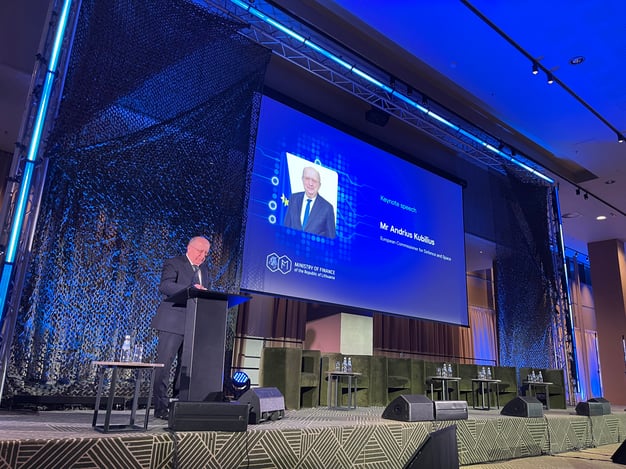
Mr. Andrius Kubilius, European Commissioner for Defence and Space addresses the conference
Why investment is needed to protect the EU Eastern Border
From the Black Sea to the Baltic, the European Union’s States on the Easter Border know they must invest more of their annual budgets in preparing for an invasion on the scale of Russia’s invasion of Ukraine. Spending must increase because their current defences would be overwhelmed in a matter of days in the event an attack.
That was the wake-up call given at the high-level strategy conference our CEO Jurga Zilinskiene MBE and I attended in Vilnius on Friday, following Jurga's keynote address at the Vilnius AI Summit. Mr. Andrius Kubilius, European Commissioner for Defence and Space, Finance Ministers and other experts from the Baltic and Nordic states explained what needed to be done and priorities for investment in defences.
Defence infrastructure with a dual use
A central theme in the discussions which included Mr. Sergii Marchenko, Minister of Finance for Ukraine, was the assertion that where feasible, public money must be invested into infrastructure that has a dual use such as hospitals, roads and power networks because these create long-term value to the nation that weaponry alone does not.
Priorities for defence of the Eastern Border
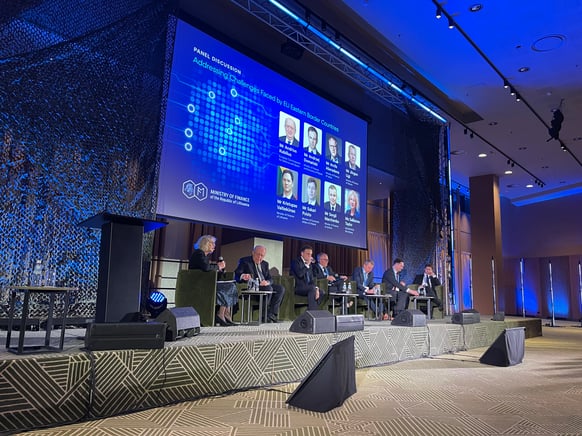 In the second of two panels, experts were asked what the key priorities must be to improve preparedness for an attack. Key priorities highlighted across the discussion:
-
Pan-European capability projects: Including European Defence Projects of Common Interest such as eastern border surveillance, air and missile defence, drones and counter drone systems, space-based protection, and maritime domain awareness.
-
Civilian defence and preparedness: A strong message that resilience must be built before crisis escalation, with prepared infrastructure, connectivity, stockpiles and clearly defined thresholds for mutual assistance. Article 42.7 only works if the groundwork is already in place.
-
Long term defence and security funding: With major negotiations ahead (including a €150bn scale European investment effort), speakers stressed the importance of sustained firepower for defence, space, and security capabilities made and developed in Europe.
-
Unlocking private capital and risk taking: Repeated calls to move beyond excessive risk aversion; using EU instruments, EIB support, defence equity funds and Invest EU to crowd in private investment, especially for SMEs and innovators.
-
Innovation, scale up and integration with defence users: From identifying real world threat needs on the eastern border, to investing in firms, testing solutions with defence forces, and accelerating procurement and deployment.
-
Deep integration of Ukraine: From continued funding to joint industrial production, and concrete capability projects, including work on large scale drone defence concepts, fully embedded within Europe’s defence architecture.
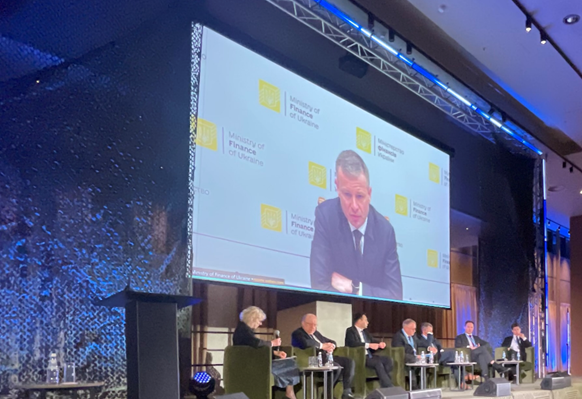
Mr. Sergii Marchenko, Ukrainian Finance Minister addresses the audience
The consistent message from all experts was that resilience requires acting together, starting now, and aligning funding, innovation, infrastructure and defence in a single European effort.
The need to invest in AI to fight AI-enabled frauds
Their sobering message of the consequences of not being adequately prepared, instantly reminded me of my own appeals for governments to back development of new AI assisted Fraud Tech solutions to protect against the swarm of frauds. These increasingly sophisticated attacks include millions of fake ads on social media, along with employment and romance frauds.
Alarmingly, as the ACCA has reported, criminals are now introducing AI tools to identify victims and hyper-personalise attacks on an industrial scale resulting in enormous financial, economic and psychological harm to society. The speed and scale of fraud attacks is unlike anything the world has seen since the COVID19 pandemic when organised criminals exploited weaknesses in financial systems.
Rogue states know that fraud is a powerful weapon
As the war in Ukraine and the Middle East illustrate, new technologies like drones are disrupting conventional tactics in battle, with powerful consequences. Therefore, it is little surprise that frauds and cyber-attacks are now part of the arsenal in modern, hybrid warfare.
Like controlling a military drone far from the frontline, those who perpetrate fraud understand that ransomware attacks and frauds are a highly effective means of both accumulating vast sums of money, and damaging trust in institutions. Moreover, the risk of being caught is almost non-existent.
Benefits of introducing AI to fight AI enabled fraud
My appeal to Finance Ministers is to understand how investing into a new AI powered infrastructure that protects the citizens from sophisticated fraud attacks is a perfect example of a dual-use solution that delivers a tangible return on investment in times of peace and conflict.
Importantly, Lithuania and the Baltic States are a powerhouse for tech innovation, and indeed, the ethical, sovereign AI models and human-in-the-loop AI verification tools we develop in own GAI Labs is testimony to this sensational spirit.
I would like to express my sincere gratitude to Mr Janus Kizenevic, organiser of the event for kindly inviting Jurga Zilinskiene MBE and me to join the event.
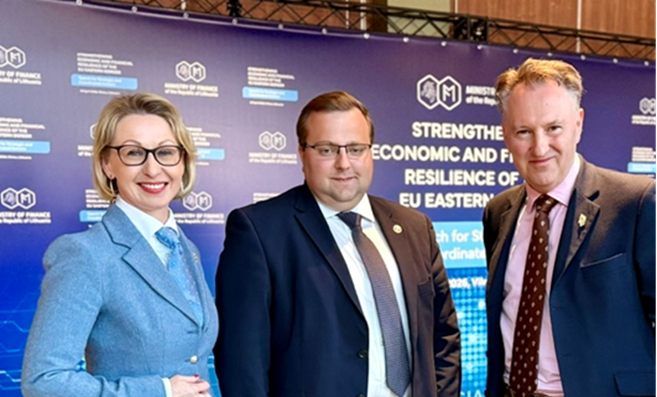
Mr Janus Kizenevic (centre) Lithuanian Vice Minister of Finance with Jurga Zilinskiene MBE and David Clarke


