

As artificial intelligence dominates headlines, boardrooms and investment decisions, one question matters most:
What will make humans most valuable in an AI-powered world?
This was the central theme of Panel 1 at the Lithuania City of London Club’s (LCLC) 20th Anniversary programme: Who Will Build the Future? Talent, Skills and Workforce Development in the Age of AI.
The panel’s message was optimistic and powerful: the future will belong not to those who compete with machines, but to those who develop the human skills machines cannot replicate.
Panel 1: Who will build the future?
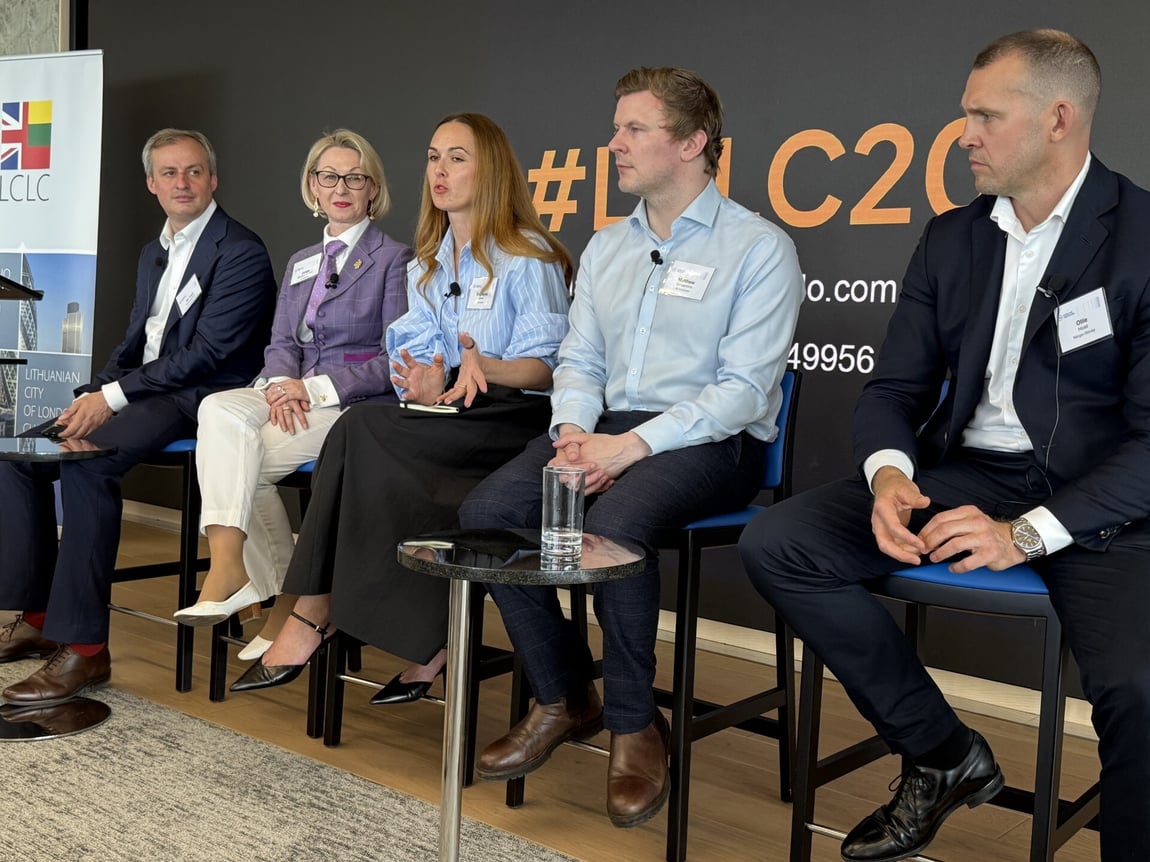
Speakers from left to right: Dr Yury Romanenkov; Jurga Zilinskiene MBE; Evghenia Iarina; Matthew Blakemore; Ollie Hoad.
Moderated by Dr Yuri Romanenkov, the discussion focused less on technology itself and more on people: how leaders adapt, how education evolves, and how individuals learn to work with increasingly capable machines.
The human skills that will shape the future
Evghenia Iarina of Coursera highlighted a striking trend: while enrolment in AI courses is growing fast, so too is demand for courses in critical thinking. Technical knowledge matters, but it is not enough.
To succeed, she pointed to the human capabilities that help people evaluate information, challenge assumptions, solve complex problems and work well with others:
-
Critical thinking
-
Creativity
-
Curiosity
-
Communication
-
Collaboration
Her message was clear: AI should be learned and used as a tool, but the winners will be those who combine technical skills with strong human judgement.
Why human judgement still matters
That theme was reinforced by Jurga Žilinskienė MBE, Founder and CEO of Guildhawk, whose company has pioneered language technologies and AI-enabled communication for more than two decades.
“We have always had problems with judgement,” she observed. “People make bad decisions. AI didn’t create that problem.”
Rather than replacing decision-makers, Jurga argued that AI is exposing long-standing gaps in leadership, education and critical thinking. Her challenge was simple: human capability must keep pace with technological change.
“What I would like to see,” she said, “is more investment in education at executive level and in helping people make better decisions.”
Her point landed strongly: skills gaps did not suddenly emerge with AI. AI has simply made them harder to ignore.
Creativity is becoming more valuable
Jurga also reflected on her long-standing involvement with Sheffield Hallam University, where earlier conversations about future employer needs pointed not only to technical skills, but to philosophy, debate, creativity, reasoning and curiosity.
As AI becomes increasingly capable of generating information, analysing data and automating routine tasks, the ability to think creatively becomes more important, not less.
This aligns closely with Guildhawk’s philosophy that technology should enhance human expertise rather than replace it.
The future belongs to people who can ask better questions, challenge assumptions and bring imagination to complex problems.
Human connection remains irreplaceable
The panel also addressed concerns about younger generations growing up in an AI-driven world.
Ollie Hoad of Morgan Stanley offered a complementary view on talent and leadership: knowledge work is changing rapidly, but genuine human relationships remain invaluable.
Whether through sport, music, teamwork, learning, business or leadership, the ability to connect meaningfully with others will continue to distinguish successful people.
“No machine can take away our humanity.”
Understanding AI’s limits
Matthew Blakemore of AI Caramba! added a practical warning from his experience in artificial intelligence: leaders must understand not only what AI can do, but where its limits and risks lie.
As businesses deploy AI agents and autonomous systems, executive education becomes critical. Human oversight is not optional; it is essential.
A powerful opportunity for Lithuania
The panel was also optimistic about the opportunities for smaller nations such as Lithuania, where creativity, mathematical strength, entrepreneurial thinking and adaptability can become powerful advantages.
In an AI-enabled economy, scale matters less than it once did. A single talented individual can now build something globally significant.
The real future of work
The most valuable skills of the future will be profoundly human: Creativity. Curiosity. Critical thinking. Communication. Collaboration. Judgement.
As AI evolves, organisations that invest in these capabilities will be best positioned to thrive, and individuals who develop them will remain indispensable.
Because in the age of artificial intelligence, it is ultimately human intelligence and human imagination that will make the difference.
Guildhawk thanks the Lithuanian City of London Club for organising this thought-provoking 20th Anniversary programme and congratulates the Club on two decades of connecting Lithuanian professionals in the City of London. We were delighted to see education, creativity, languages and human-centred innovation placed at the heart of the discussion about the future of work.
Media enquiries:
info@guildhawk.com


